
Post
Can Filmmaking Survive Without AI?
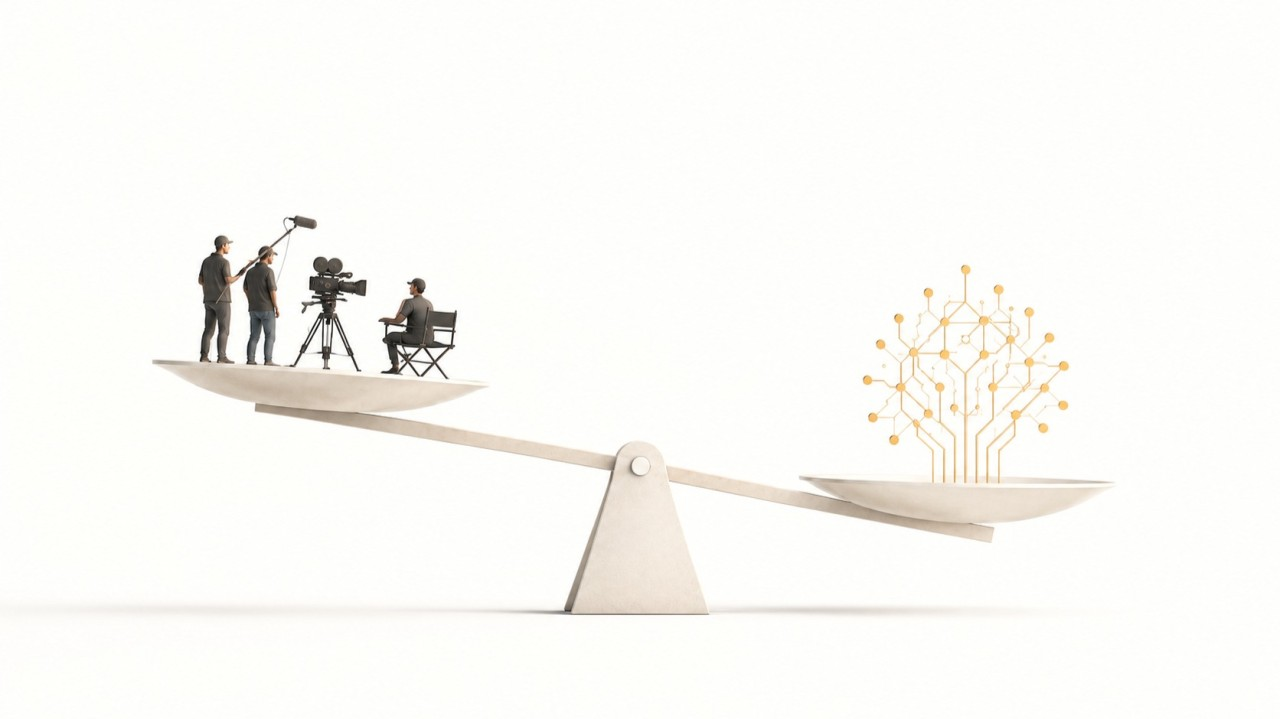
The debate about artificial intelligence in filmmaking is usually presented as a conflict between technology and creativity. Will AI replace writers? Will it replace actors? Will entire films eventually be generated without cameras, sets or crews? These questions matter, but I suspect they are not the real reason AI will become unavoidable. The deeper reason may be economic.
As societies become wealthier, the cost of human labor rises. People need better wages because housing, food, education, healthcare and almost everything else becomes more expensive. Expectations around working conditions, security and quality of life also increase. That is progress. There is nothing wrong with it. But it creates a problem for industries that remain heavily dependent on human time, and filmmaking is one of them.
A professional film still requires large numbers of people working for weeks, months or sometimes years. Scripts must be developed, locations found, sets built, actors directed and scenes lit, recorded, edited, mixed and finished. Technology has changed how all of this happens, but it has not always reduced the amount of work. Digital cameras made shooting easier, so productions began shooting more material. Visual effects made impossible images possible, so films became more ambitious. Faster editing systems made changes easier, so filmmakers and executives requested more versions. Every efficiency created new expectations. Filmmaking became technologically more advanced without necessarily becoming structurally cheaper.
At the same time, the people making films need to earn more. This creates a contradiction. The human beings making films need higher wages to maintain a reasonable standard of living, but the economic value of an individual film does not automatically rise with those wages. A cinema ticket cannot become endlessly more expensive. A streaming subscription has a limit. Broadcasters, distributors and audiences will not simply keep paying more because the cost of making films has increased. The cost of making films rises, while their market value does not necessarily rise with it.
For decades, the industry tried to solve this problem in familiar ways. Productions moved to countries with lower labor costs. Governments introduced tax incentives. Shooting schedules became tighter. Crews were reduced. Independent filmmakers relied on goodwill, deferred payments and people working below their normal rates. But these solutions do not remove the underlying tension. They move it somewhere else. When production moves to a cheaper country, wages there will eventually rise as well. When schedules become shorter, crews absorb the pressure. When people work for less because they believe in the project, the real cost has not disappeared. Someone is simply paying for it personally. Goodwill is not an economic model.
It would be too simple to say that rising labor costs alone caused the decline in studio filmmaking. The industry has also suffered from weaker theatrical performance, the contraction of streaming, risk aversion, consolidation, expensive corporate structures and a growing obsession with franchises. Studios have created many of their own problems through inflated star salaries, rights costs, reshoots, executive layers and productions that became too large to control. But underneath all of this remains a basic reality: filmmaking is labor-intensive, while the market is becoming less willing to absorb its rising costs. The industry is being squeezed from both sides. Audiences will not pay endlessly more, while the people making films cannot reasonably be expected to earn less.
This is where AI enters the equation, not simply as a creative tool, but as a productivity tool. Its first major impact may not be the creation of complete films without human involvement. It may be the removal of thousands of hours of repetitive, technical and organizational work surrounding the creative process. Planning can become faster. Information can be analysed and organized automatically. Visual ideas can be explored before expensive decisions are made. Footage can be searched and prepared more efficiently. Dialogue can be translated and synchronized. Parts of editing, sound, visual effects and production administration can be accelerated. AI does not have to replace the filmmaker to transform filmmaking. It only has to allow filmmakers and crews to achieve more within the same amount of time.
That is why I suspect its use will become unavoidable. Not because every filmmaker will want it, because AI will suddenly become more creative than human beings or because human labor has lost its value. AI will become unavoidable because the industry will no longer be able to afford using human labor for every part of the process. Once one production can achieve a certain result with fewer resources, competing productions will feel the pressure. A producer who can create a particular level of quality for five million will have an advantage over one who needs eight million to deliver something similar. Financiers, distributors and platforms will adjust their expectations. What begins as an optional advantage eventually becomes the new standard. Companies rarely adopt transformative technology simply because it exists. They adopt it because competitors become more productive with it. Once one production can consistently deliver comparable quality faster or with fewer resources, others have little choice but to follow. AI is therefore unlikely to spread because everyone embraces it. It will spread because competition leaves increasingly little alternative.
This has happened before. Digital cameras, digital editing, visual effects and digital distribution were once choices. Eventually, refusing them stopped being a purely artistic decision and became an economic one. AI will probably follow the same path, but faster, because it can affect development, production, post-production, marketing and distribution at the same time.
That does not mean every filmmaker must use AI in the same way. A division will emerge. Commercial filmmaking will increasingly use AI wherever it can reduce time, repetition and cost, while preserving human involvement in the areas where judgement, originality, performance and taste create visible value. Other filmmakers will deliberately reject parts of the technology, and their films may become more artisanal. That is not an insult. Handmade animation, celluloid photography, practical effects and live performance can become more valuable precisely because the human process is visible. But artisanal filmmaking comes with an economic consequence. It is slower, more labor-intensive and harder to scale. It often depends on smaller crews, public funding, private patrons, deferred compensation or people accepting less because they care about the work.
Some of those films may become extremely successful or culturally important, but the model will remain constrained. A filmmaker who rejects AI may still make great films, just as a photographer can still work with physical film or a furniture maker can build every piece by hand. But that filmmaker will be choosing a more expensive method in a market that may not pay for the difference. That is the choice filmmakers will increasingly have to make: not whether they are for or against technology, but what kind of filmmaking they want to practise and who will pay for it.
There is also a danger in assuming that AI will automatically make films cheaper. History suggests that when technology reduces the cost of one task, ambition expands to consume the savings. If AI makes visual effects faster, filmmakers may demand more effects. If it makes editing easier, producers may request more versions. If it allows a small team to create an entire world, audiences may quickly begin to expect every film to contain one. AI may reduce the cost of individual tasks without reducing the final budget. It may simply allow more to be created for the same amount of money.
There is another uncomfortable possibility. The benefits of productivity do not automatically go to the people doing the work. AI could make filmmaking more sustainable, but it could also allow companies to demand more output from fewer people. It could protect creative labor or place even more pressure on those who remain. Technology does not decide how its benefits are distributed. People, companies, governments and institutions do. AI is not the force making these decisions. We are.
The real debate should therefore not be about whether AI is good or bad. It should be about where human involvement is essential and where it is simply expensive repetition. A powerful performance may justify weeks of rehearsal. A distinctive set may justify a team of craftspeople. A cinematographer's eye may define the entire emotional identity of a film. But hours spent manually searching files, creating routine variations, reorganizing information or correcting technical details will become increasingly difficult to justify when machines can complete them almost instantly.
The challenge will be to protect human labor where it creates meaning, rather than protecting every existing task simply because that is how films were made before. Used badly, AI will flood the world with generic images and disposable content. Used intelligently, it may reduce the cost of execution enough to preserve the people who provide the vision.
AI may not save filmmaking by removing filmmakers. It may save filmmaking by making it economically possible to preserve the parts of filmmaking where human creativity, judgement and taste create the greatest value. Whether that future benefits filmmakers or merely demands more from fewer people will depend less on AI itself than on the choices we make about how we use it.